
I’m pretty sure you don’t know who I am, so here goes…
I grew up in East Texas. Our family moved from Dallas to Anchorage, when I was 10.
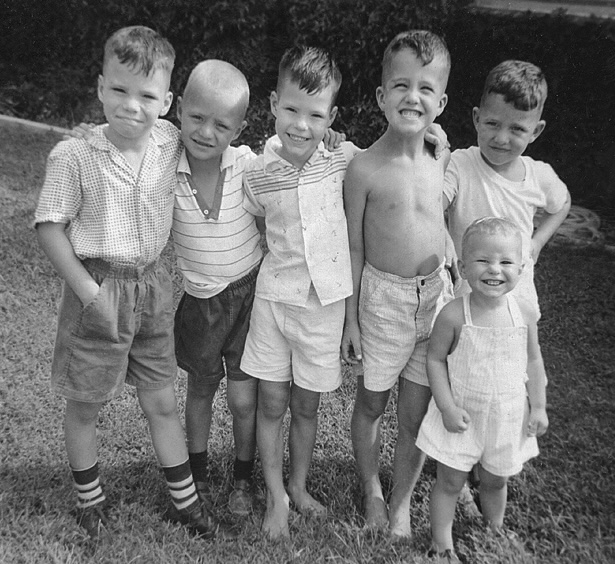 Neighborhood kids in 1959, suburban Texarkana, Texas, I’m on the left
A year after making the move, we had the misfortune of experiencing the ‘Great Alaska Earthquake’ of Mach 27th, 1964. School was out that day for ‘Good Friday’. When the earthquake struck (5:36PM), we were all sitting on the floor watching ‘Fireball XL5’. For the first couple of minutes, the adults huddled us into a group to wait it out. At some point we were ushered outside until the ground stopped moving, about five minutes total. I still remember the sound of a telephone pole creaking in the concrete sidewalk, as it whipped back and forth.
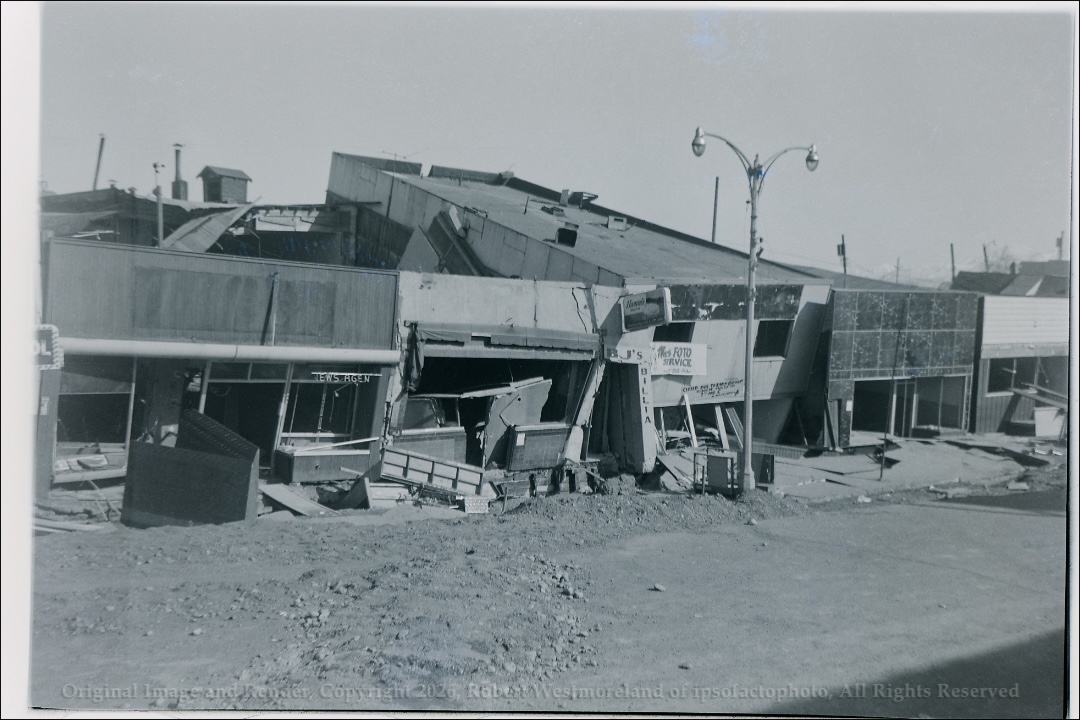 Downtown Anchorage 4th Avenue, taken about two weeks later
At the time, we lived just off the Parkstrip next to Lou’s Market. I also remember the smell of booze running down the concrete steps of the store. That summer, us kids biked all over downtown, Government Hill and out by the inlet to check out the damage. USGS was busy on the Parkstrip drilling core samples for the report they eventually released.
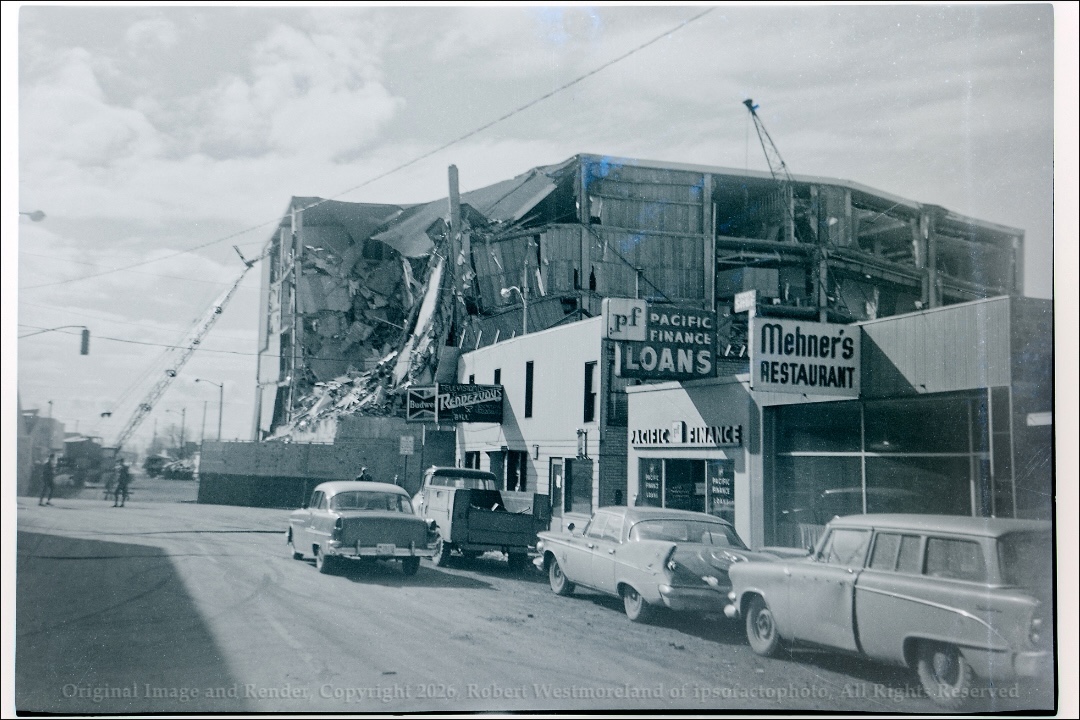 Downtown Anchorage, JC Penney building, taken about two weeks later
I’ve managed to hang onto a few B&W negatives I took, done with a Brownie box camera. These old negs are not particularly good, but they are mine.
Model Rocketry… fun for Geeks.
An interest in building and shooting model rockets dominated most of my Junior High years. My first science fair project was dedicated to model rockets. Two years later, my tenth grade science fair project was based on a much larger model rocket using a composite polymer rocket motor. The payload was assembled from an altimeter taken from a weather balloon, coupled to a DIY transmitter, sending a modulated signal down to the ground to a small paper chart recorder.
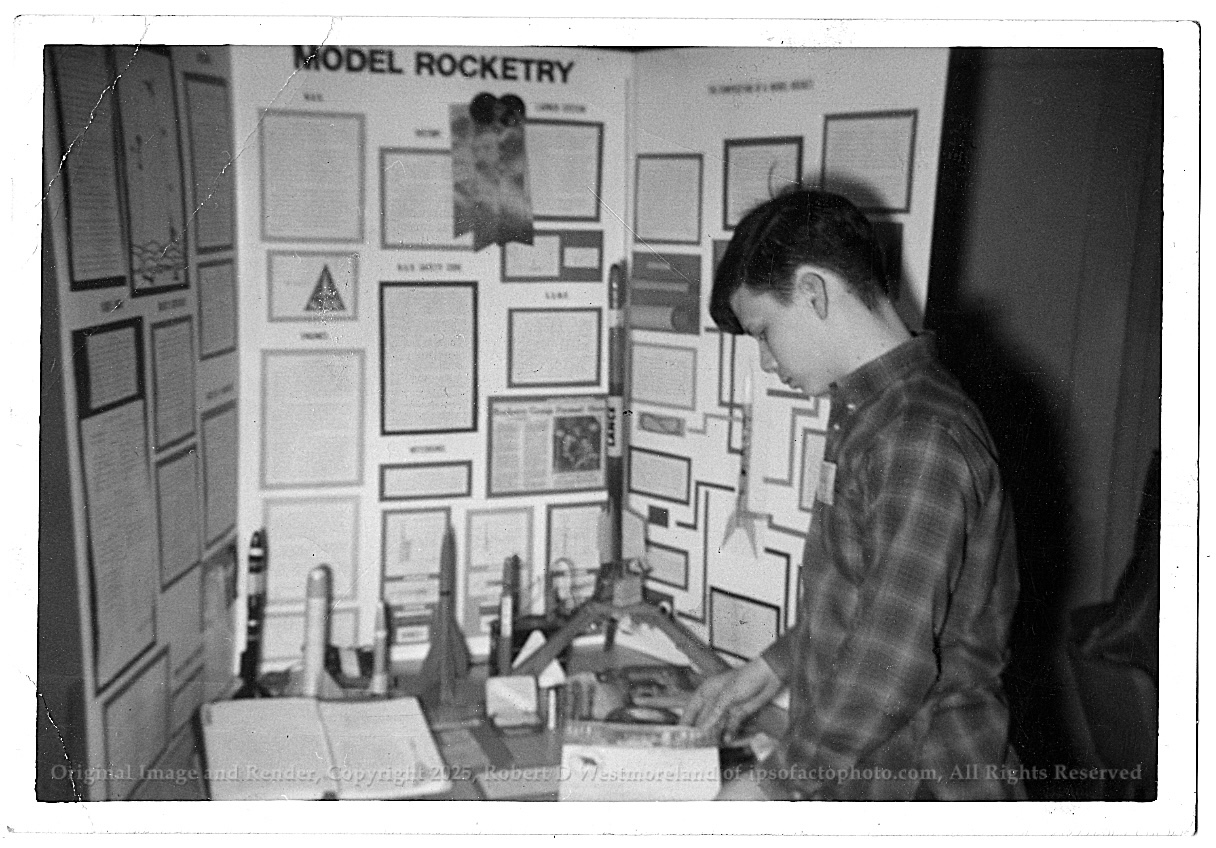 My first Science Fair project, 8th grade
The goal was to track altitude in real-time. I never actually finished it, but the idea was sound. Keep in mind, it was the late 1960’s. Along with a dozen other kids it got me a seat on a C-130 to go tour the ‘Clear Radar Early Warning’ site the following summer. We all saw the ‘Big Board’ light up with a demo of the US being invaded by Russia.
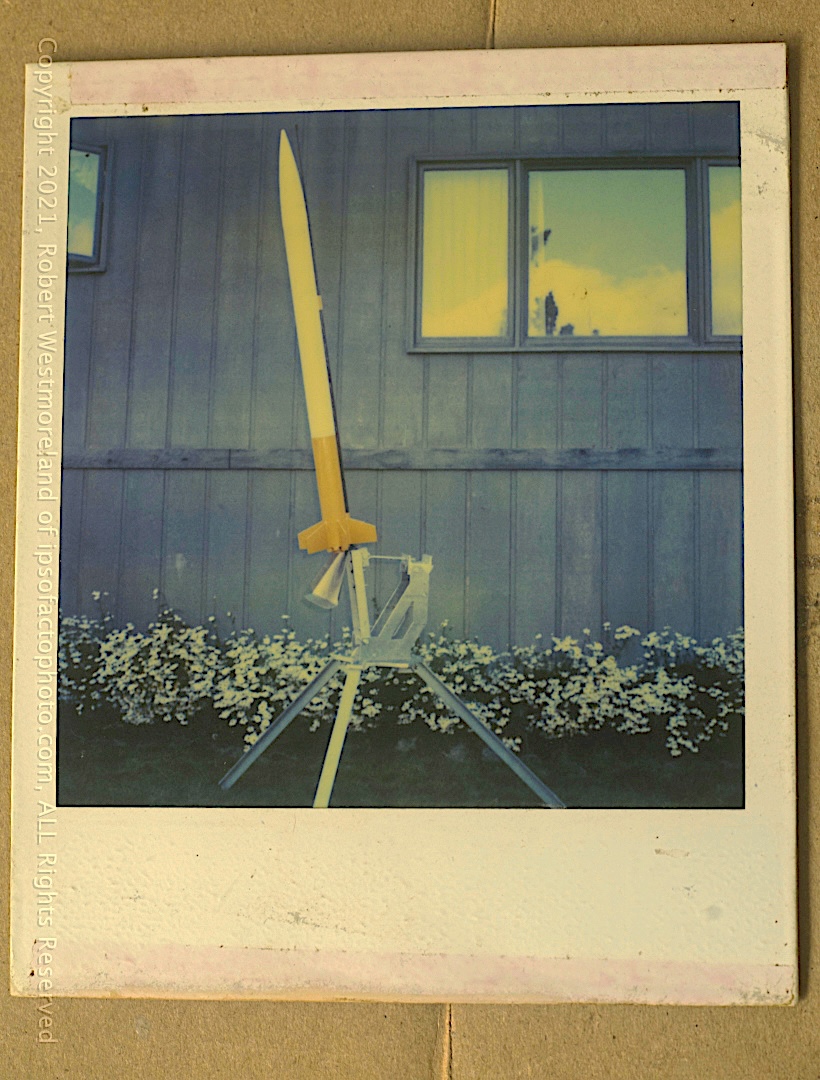 Extremely light-weight, demo model rocket
As an adult, many years later, I would make the trip to Colorado Springs for the LDRS rocket launch (Large and Dangerous Rocket Ships), a Tripoli sanctioned launch so I could (and did) qualify to shoot high power model rockets. I made the trip to the Colorado Tripoli rocket launch, twice.
Interests and focus changed in high school
The summer before starting high school, I had already decided I wanted to become a photo-offset Lithographer. At the time, that seemed like some kind of long term goal. College was not in my future. What’s more, my interest in photography did not take off until after graduating high school.
The idea of creative experimentation in the darkroom is what attracted me to Lithography and the photo-mechanical process.
Towards the end of my senior year at East High, I spent most of my time in the graphic arts and art departments, mostly working the big Robertson process camera and stressing out my art teacher Ms. Chaterton.
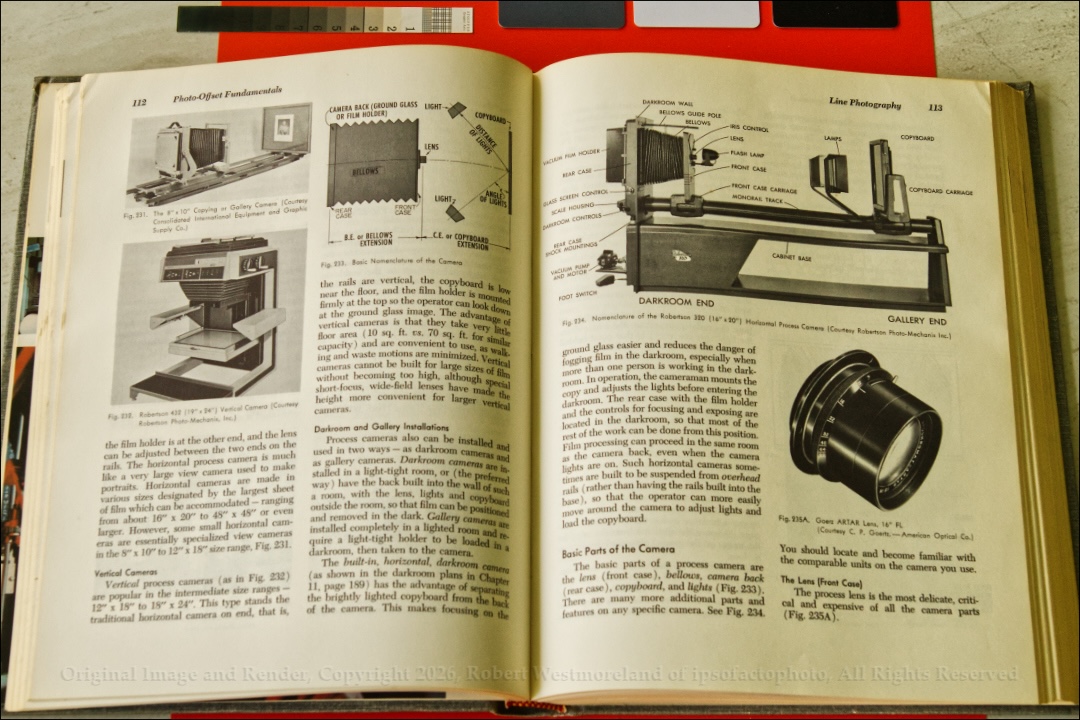 Pages from ‘Photo-offset Fundamentals’ regarding process cameras
My first commercial printing job was the summer after my junior year doing odd-jobs at a small Mom n’ Pop printshop. The lever-operated guillotine paper-cutter was particularly fun. My senior year, I worked part-time at a more upscale shop as an apprentice process camera operator and film stripper. That Union job turned full-time after high school. A little more than two years later, I got my Journeyman’s Certificate. A goal I thought would take a lifetime to achieve. I made a lot of halftones and duotones during that time. And a lot of aluminum press-plates as well.
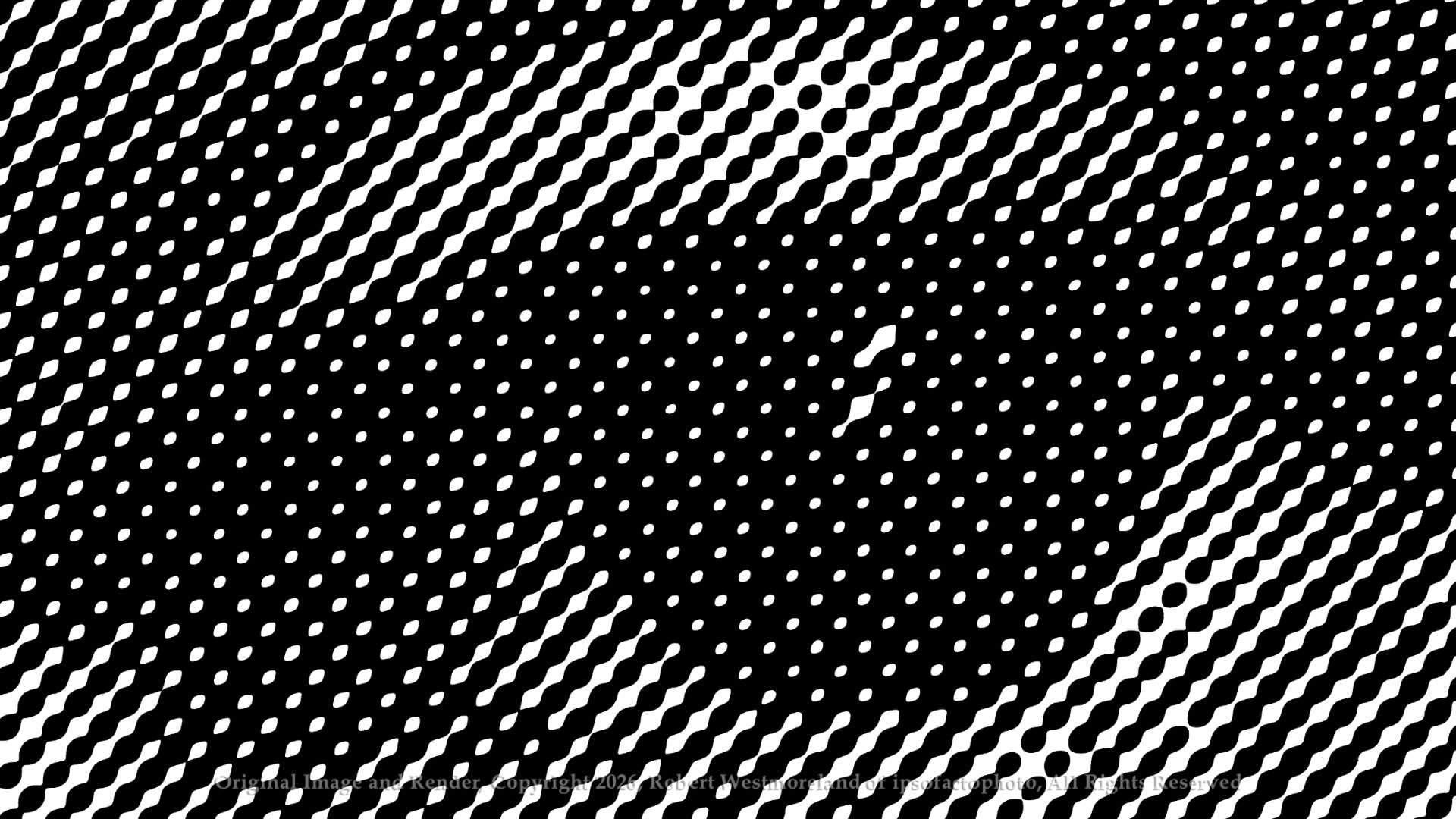 Ms Jesters eye rendered as a halftone for IFP logo Elliptical dot type
Photography as a Creative Medium in its Own Right.
Yes, I had chosen a trade over college and have no regrets for having done so. The only college class I took was a night class taught by Sam Kimura. At the time, he was a well known commercial photographer. About 5 weeks into the class, I dropped my little Rollie 35mm camera to the sidewalk ruining it. Fortunately for me, Mr Kimura loaned me one of his Nikon F SLRs so I could finish the assignments. Part of that instruction was conducted at his home studio which included a darkroom with 10 enlargers! He demonstrated how they could be used to produce prints with composited features. This was well before the age of desktop computers and Photoshop. I was intrigued. This set me on a new path predicated on the fact that photography could be more than just the simple act of capturing what the camera sees. (Although it’s often not that simple.)
 Robs mixed-media sculpture on display at AMU All Alaska Juried Art Show.
I also made it into the ‘All Alaska Juried Art Show’ at AMU. It was a mixed-media project turned sculpture in a triangular aluminum frame I had locally fabricated. It measured about 30x30x30 inches, by 6 inches thick. It was supposed to lay flat on the floor with folks walking around it, glowing cyan, magenta and yellow… changing colors as you did. Instead, the curators propped it up against the wall next to a wall outlet.
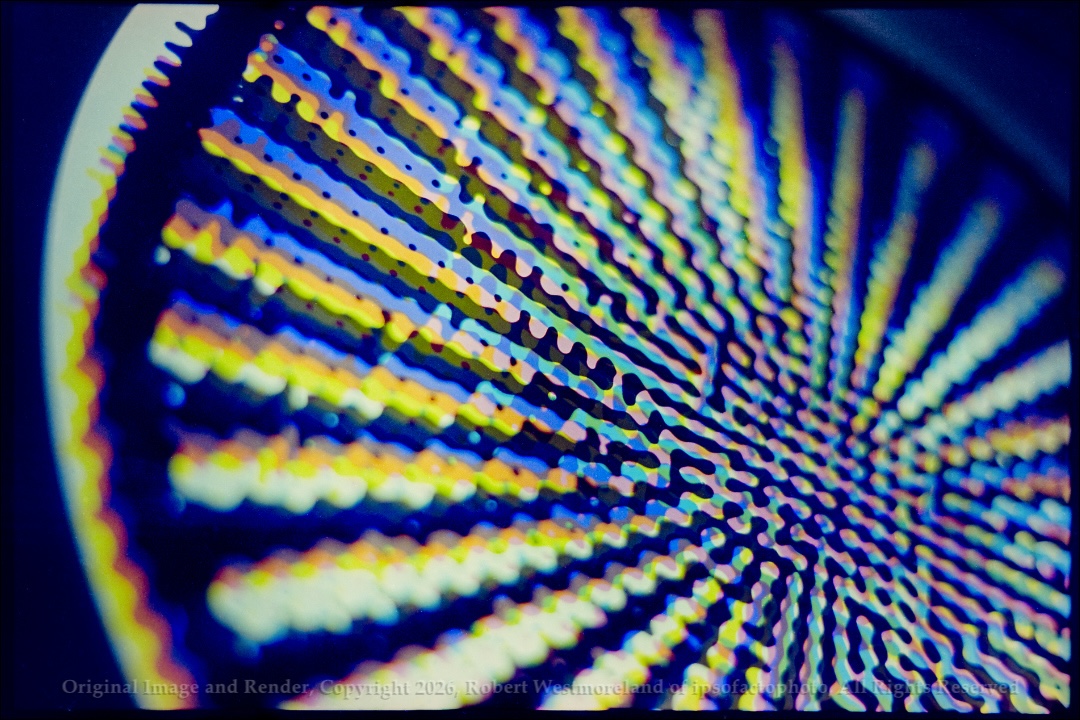 Robs ‘art project’ close-up at AMU All Alaska Juried Art Show
It was during those early years, fresh out of high school, when my interest in photography really took off. In about 1973 I bought a brand new Nikon F2 with 24mm, 35mm and 85mm lenses. I taught myself to ‘see’ by strictly shooting 35mm B&W film. I would buy Plus-X or Tri-X by the 100 ft. roll then load my own 35mm carts in the dark. After a shoot, I would process 4-8 rolls at a time, in my tiny darkroom at home. A lot of that early work went straight to the trash… I got very used to studying the 35mm negs with a 10x Loupe.
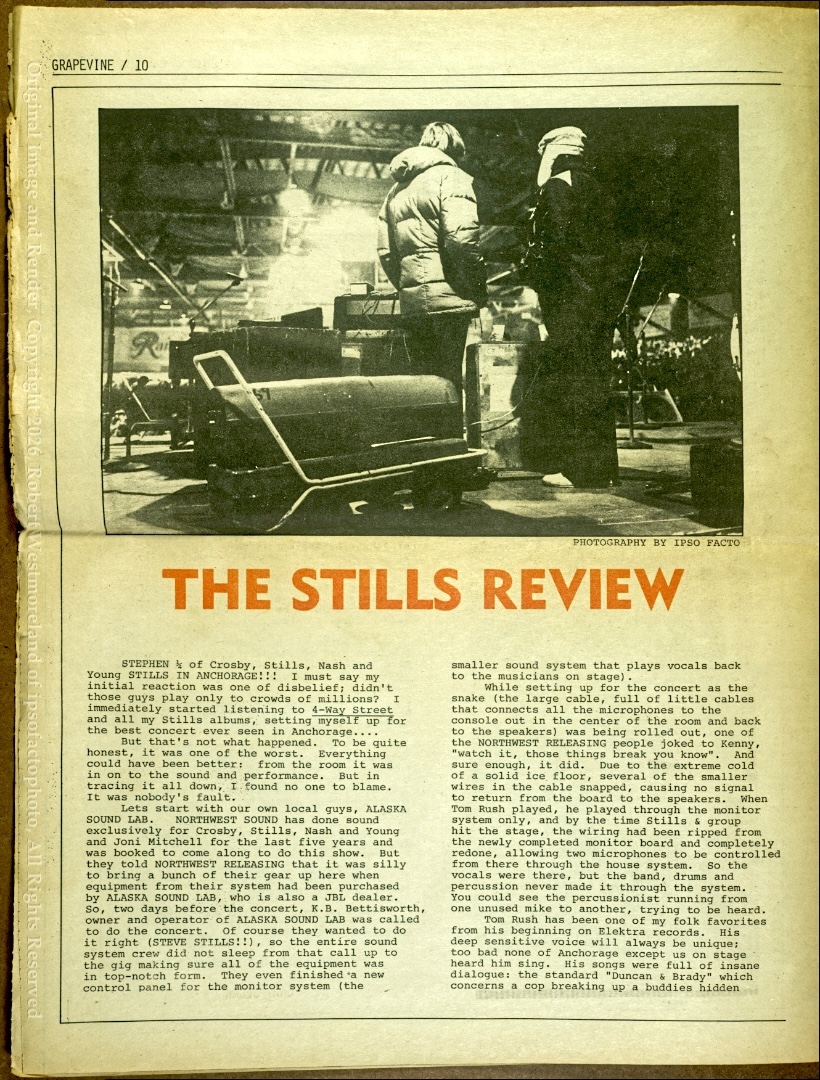 A page from the Grapevine, circa 1977, maybe?
That 3 lens kit fit a canvas gas-mask bag I dyed black. It went everywhere I did. Plus a monopod. A form of manual image stabilization based on using only one leg of a tripod. It was very effective. I still have one I use on a regular basis. It’s much more convenient than dragging around an entire tripod. I used this set along with a Sunpak 611 flash for shooting rock concerts.
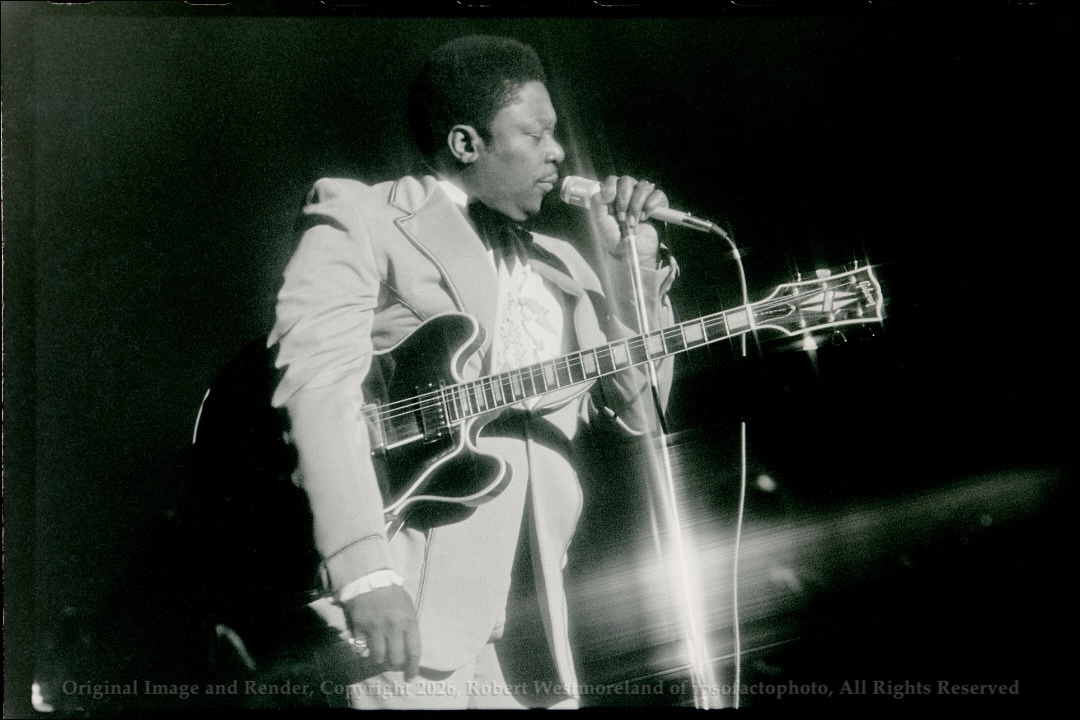 BB King in Concert at West High auditorium
While playing photographer for a short-lived bar rag, the ‘Grapevine’, I had the opportunity to photograph AND interview BB King! It was a golden moment.
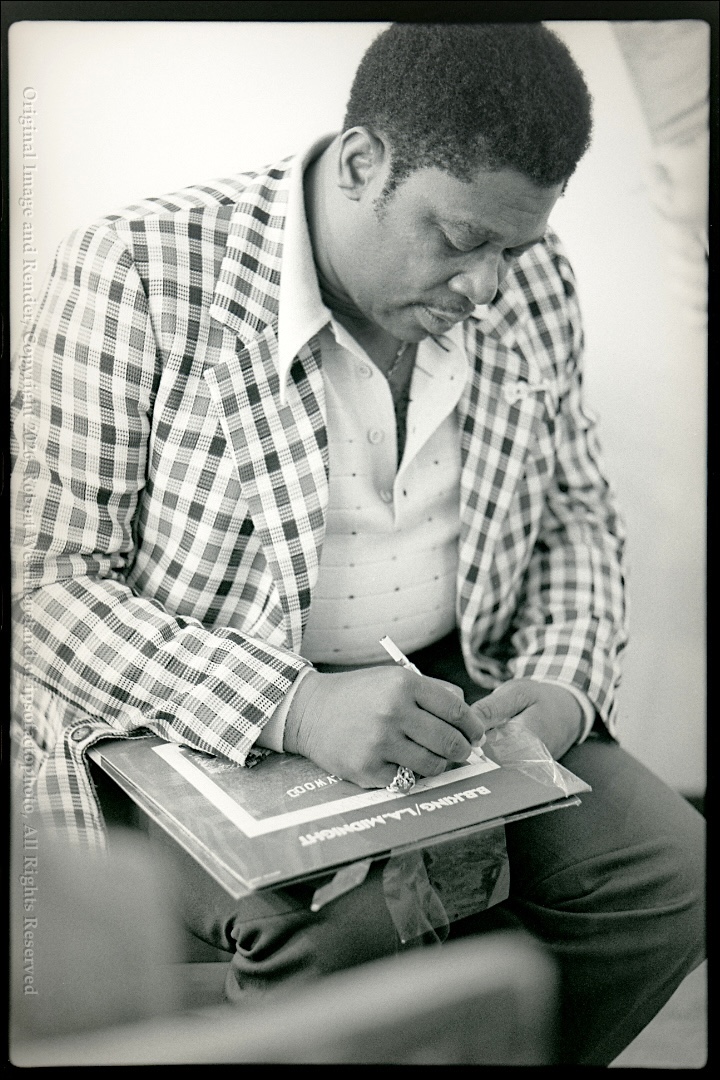 BB King taken during interview
As I grew more comfortable using a 35mm SLR, I started shooting the occasional roll of 35mm slide film… Mostly Ektachrome since I ‘could’ process that myself and a little Kodachrome as well. A few years later the heavy F2 was replaced by a full suite of Olympus OM 35mm SLRs and lenses… A couple of OM-1 and OM-2 bodies, and a slew of fast Zuiko prime lenses (fisheye – 300mm). The OM-2 is what I used to shoot thousands of 35mm slides. I still use a few of those 50 year old lenses on my digital cameras. I prefer manual focus to AF, when I’m not in a hurry.
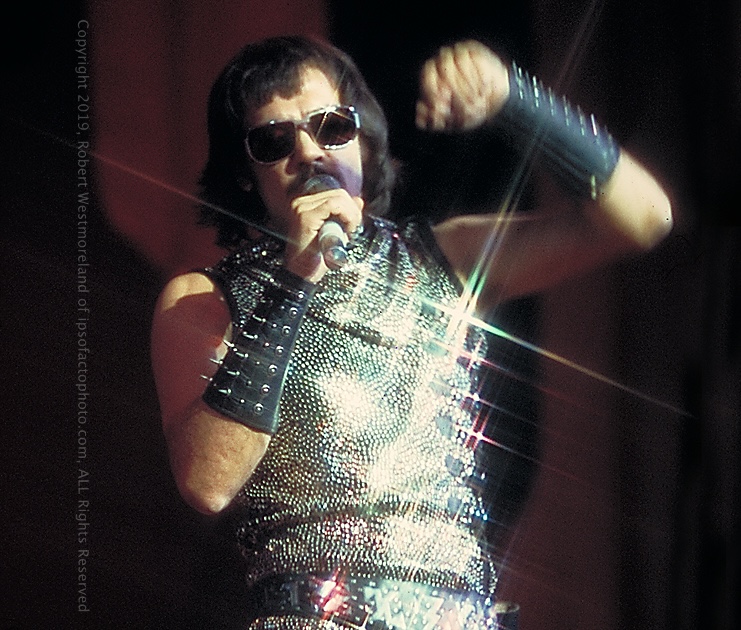 Stephen Wolf in concert, in Anchorage
Between jobs, I spent about 9 months shooting weddings. I did not enjoy it. It did not always go well. The time spent versus the return was dismal. Plus I had two weddings where the couples split-up before the prints came back from the lab, a matter of two weeks.
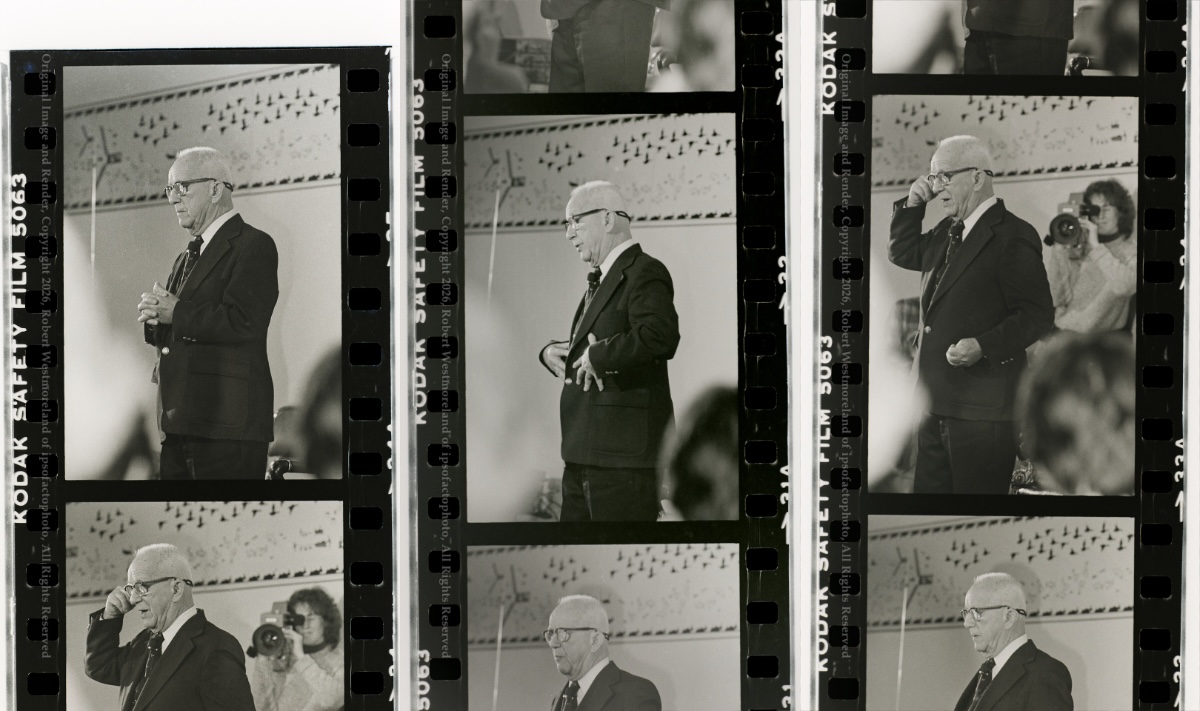 R. Buckminster Fuller speaking in Anchorage
There are a couple of people I need to mention, like Sam Kimura, because of the impact he had on me. This is another one… R. Buckminster Fuller. I saw him speak on a week night, sometime in the mid 1970’s. His presentation ran long, but I was impressed. I subsequently read several of his books.
Working Litho as a Trade Shop
My ‘day-job’ as a photo-offset lithographer in the early 1980’s lead me to assume ownership of half of a local pre-press and phototypesetting trade shop. The half that was doing the litho prep- ‘The Camera Room’. About two years into that, I secured a Hell 299L Drum-scanner that digitally imaged directly to halftoned litho film. It was huge. We could spin off screened, 4-color separations up to 20×24 with bleed.
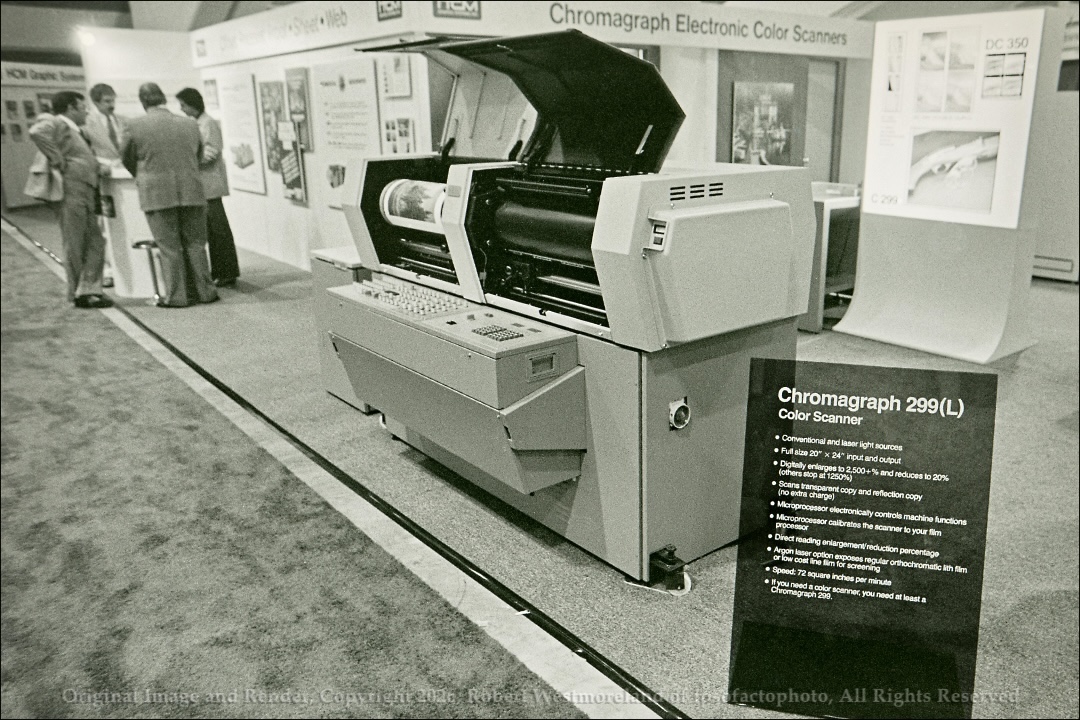 HELL 299L Drum-scanner on display at trade-show in San Fransisco
At that point I had several people working for me… a litho-cameraman, a scanner operator, a film-stripper, and an outside salesman for the larger clients. Yes, we did eventually get around to adding phototypesetting to our list of capability. The shop got big quick. As a trade service, there were no presses or bindery. I was never interested in running a printshop. They make a lot of noise.
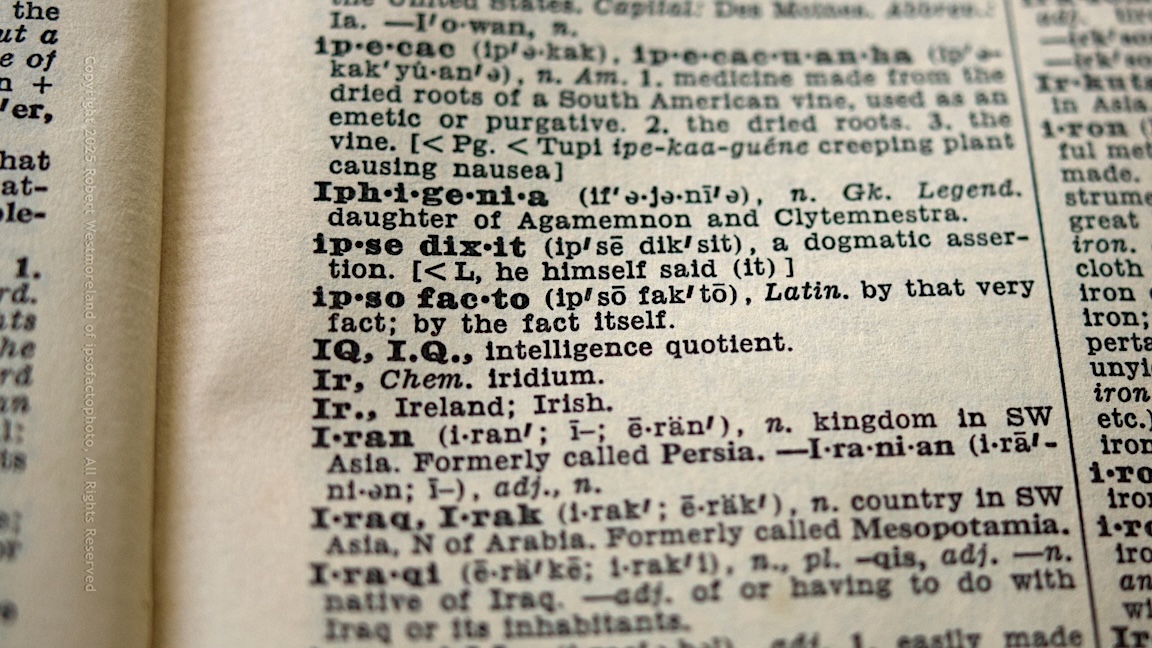 Dictionary- In search of a name
I also changed the name to IPSO FACTO PHOTO-LITHO. A name I had been using for free-lance photography since 1975. The trade shop was just off the corner of 36th and Arctic, across the street from a strip-mall. We catered primarily to ad agencies, PR firms, a few corporate oil accounts and several freelancers, all in need of prepress prep for ad placement in local print media.
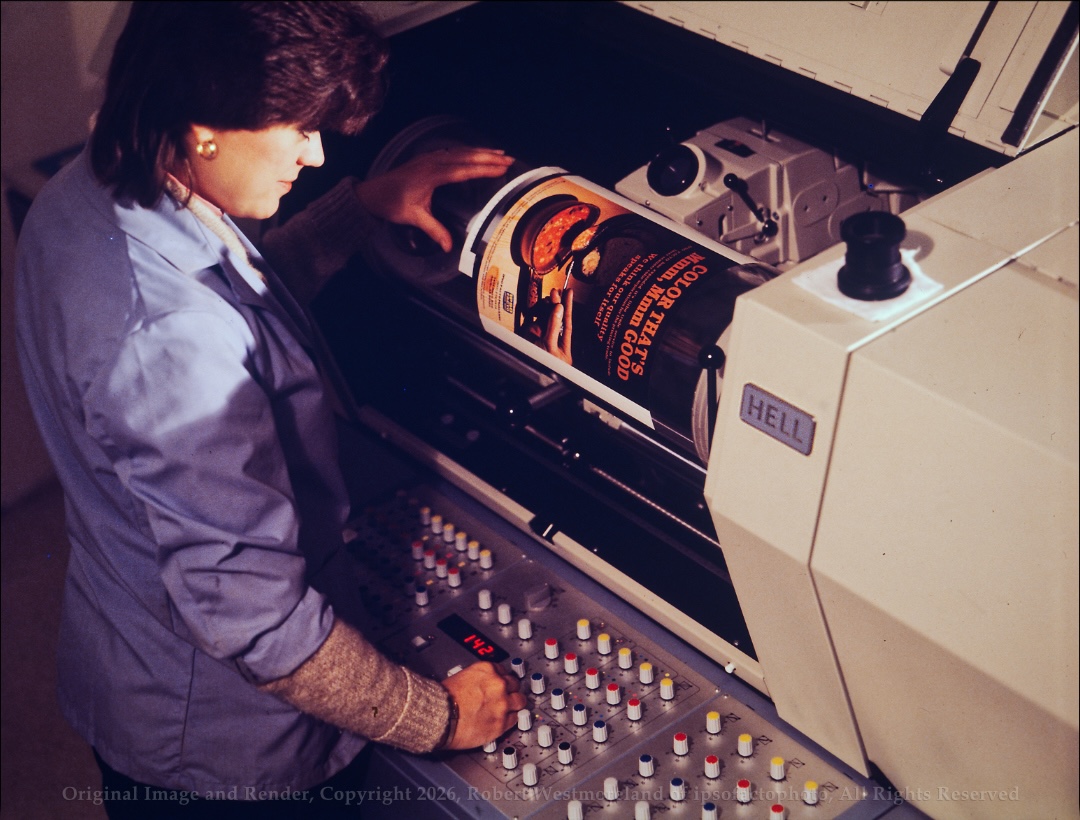 Ms Butcher at the controls of a HELL 299L drum-scanner
A little space for studio work
At this point I dedicated a small space for ‘studio shoots’. This gave me the opportunity to become proficient with medium format cameras, 4×5 view and studio lighting.
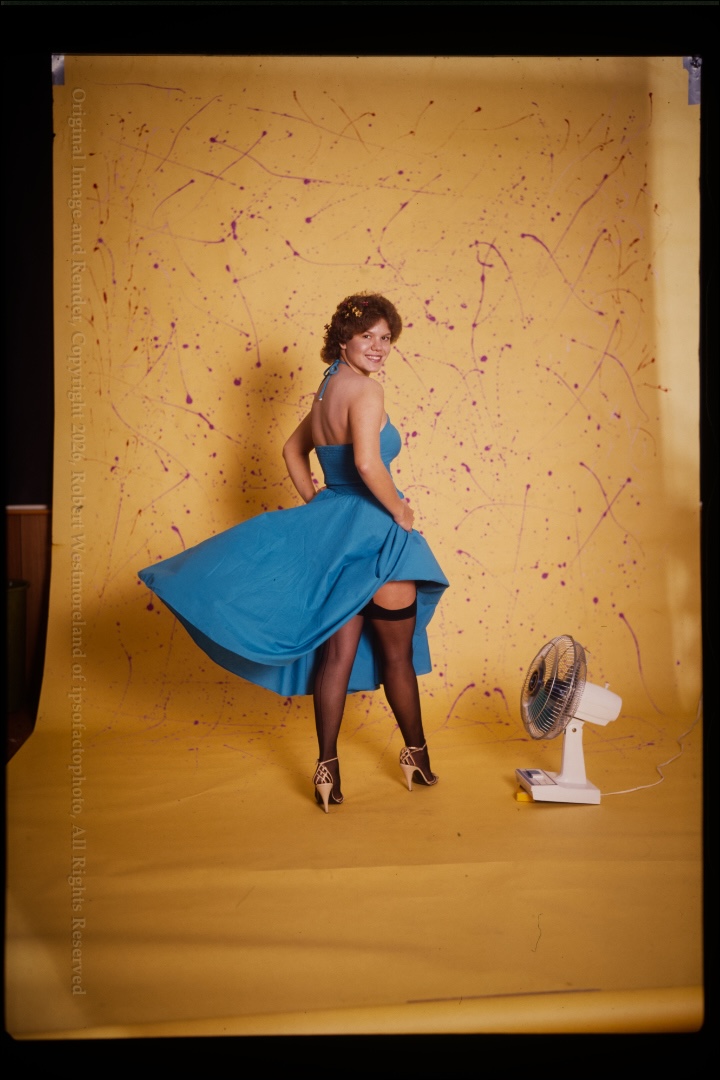 Studio Shoot- Shot with Fuji GL 6×9 rollfilm camera with 105mm lens, Ektachrome
Though there was the occasional assignment, most shoots were staged for the purposes of perfecting technique. I started with a Mamiya RB 67 with two lenses and set of simple tungsten lamps eventually adding a studio 4×5 with 3 lenses and a 2400watt/sec strobe-light power-pack.
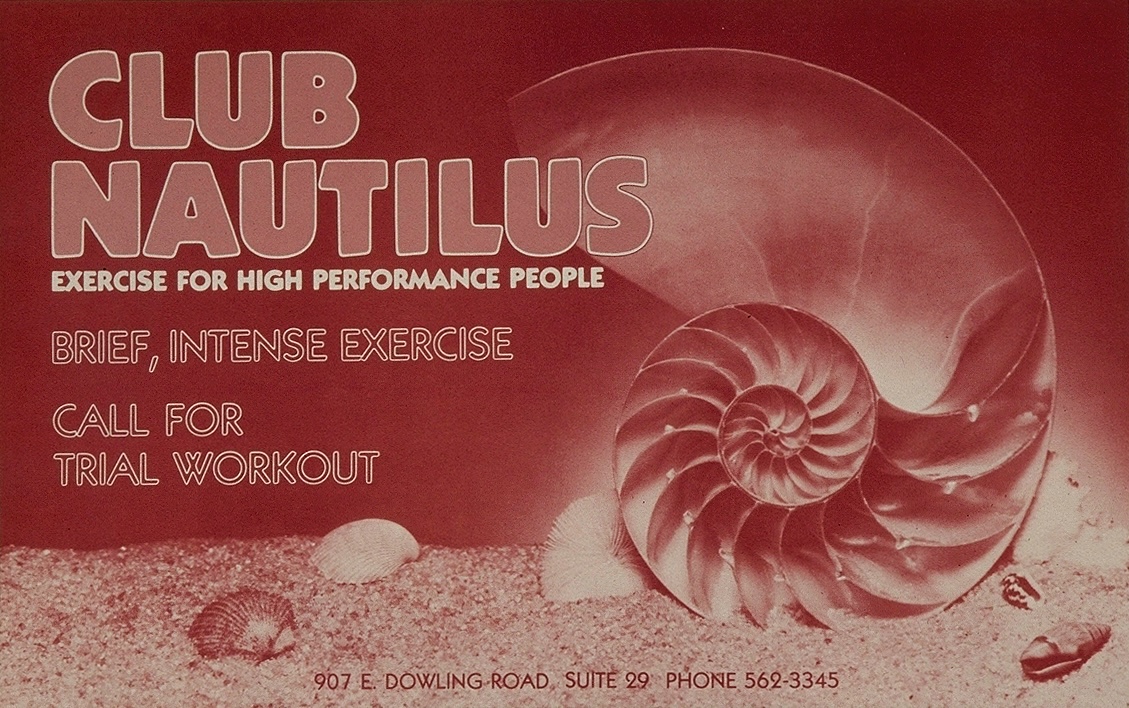 Club Nautilus poster shot as still-life, RB67 with 127mm lens
In the field, I still preferred the FUJI GL 690, a 120 rollfilm rangefinder with a large 6x9cm frame, loaded with E-6 color film. Or the RB67 for the slightly wider view. I did not regularly shoot 4×5 and almost never outside.
 Hair salon shoot, for newspaper placement, early 1980’s
Rob the pyrotechnician
In this same time period, I studied for and acquired a Low Explosive License from the State of Alaska. So I could shoot commercial fireworks. Not just photograph them.
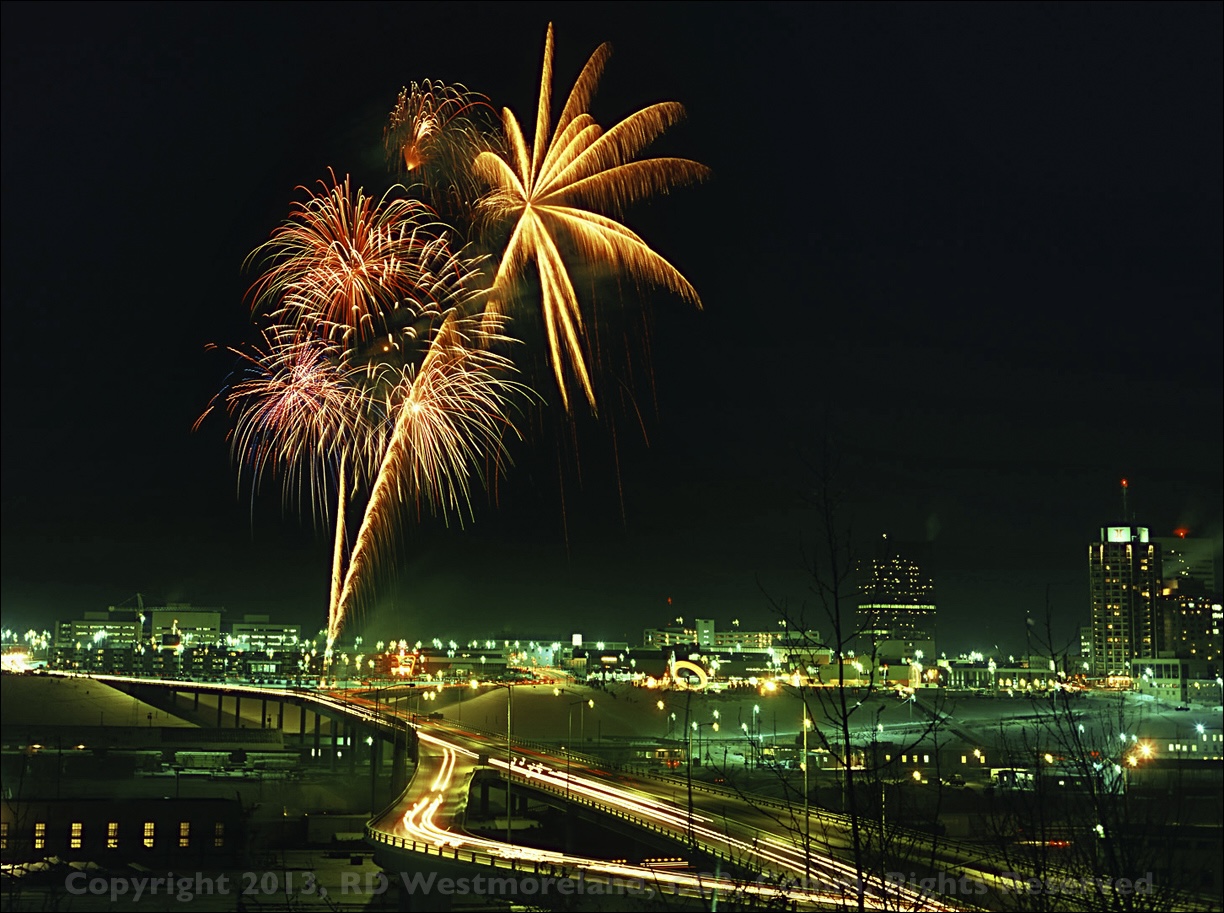 Taken from Government Hill, Fur Rendezvous fireworks show, Anchorage, AK. Camera was a Grover 4×5 and either a 65mm or 90mm Super-Angulon to Ektachrome. It was cold and windy.
The type of aerial fireworks you see at 4th of July and New Years. I once subbed for a pyro buddy and shot the New Years fireworks show in Barrow, Alaska! It was dark. Then there was the 4th of July show in Anchorage, sponsored by the Captain Cook Jaycees.
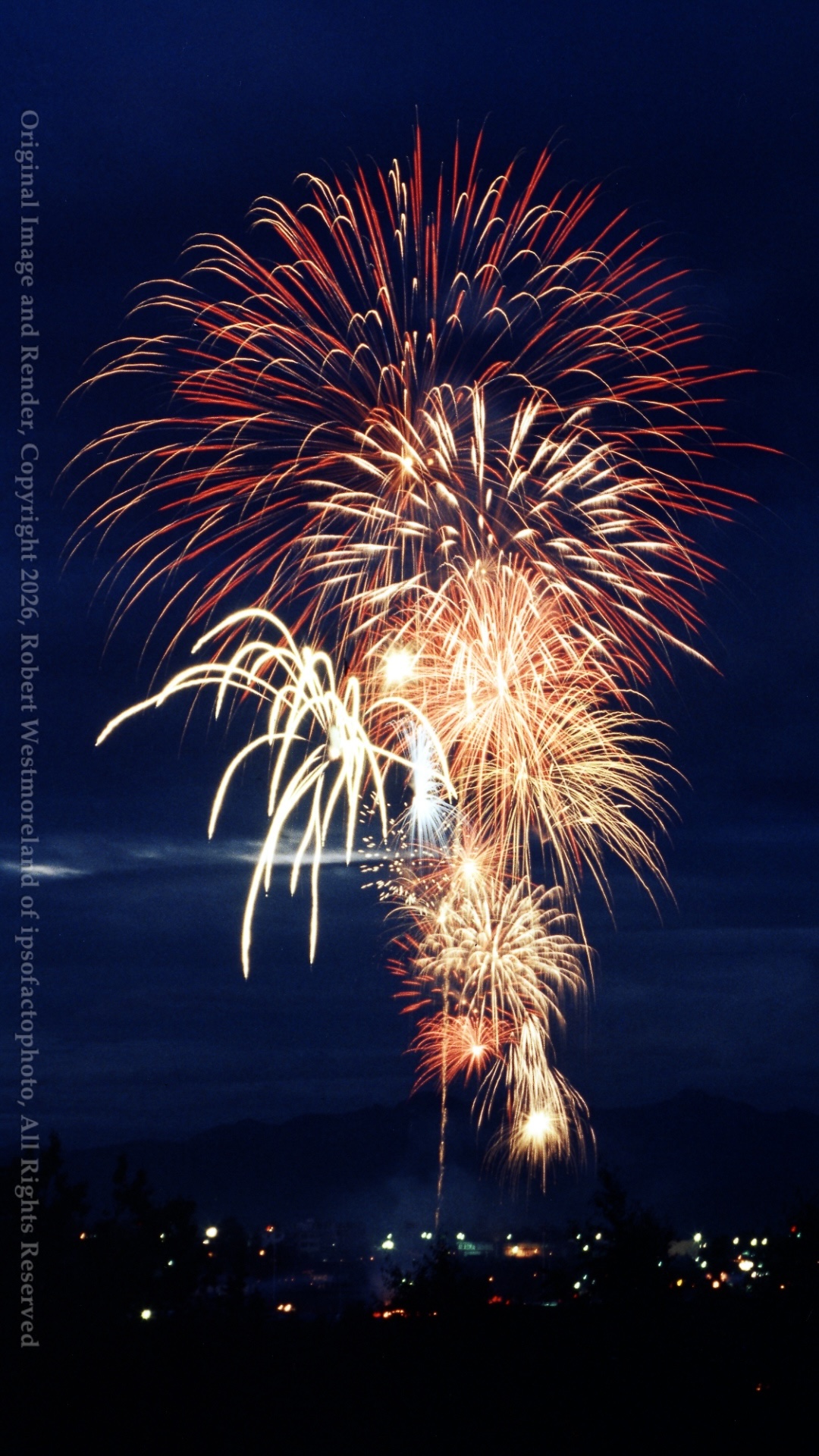 FDF finale from Fireweed Lane, late 1970’s, overcast skies really helps
As a chapter member, I was project chairman for the 4th of July ‘Anchorage Freedom Days Festival’ in 1985. It was grand! I scored JayCee ‘Project of the Year’ at state level for it. I also assisted in shooting a couple of commercial shows in Seattle. Fond memories, for sure.
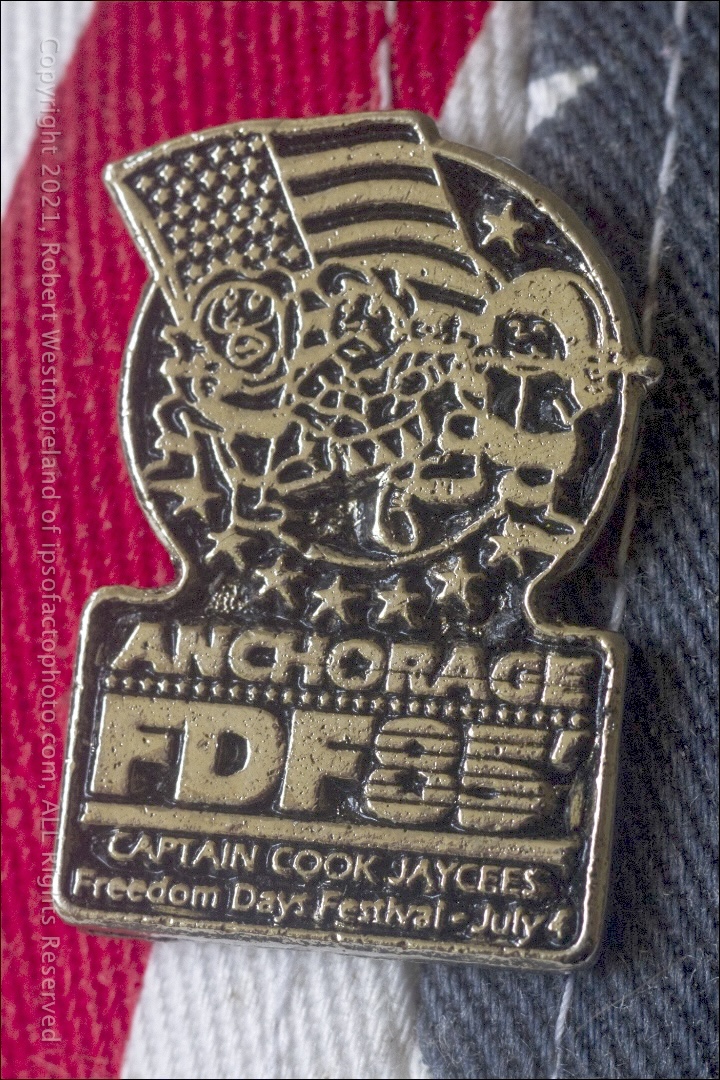 Pewter pin commemorating ‘FDF’ in 1985
Desktop Publishing was coming quick
Commercial off-set printing was a very different beast in the 1970’s and ’80’s. There were lots of Mom ’n Pop print-shops back then. Anchorage had more than a dozen. Of course desktop publishing changed everything. Litho cameras became obsolete almost overnight. By the mid 1990’s, litho film used to make off-set press plates was now spit out of an imagesetter with pagination rendered on the fly. A process camera was no longer needed. All of this was replaced a few years later by direct-to-plate laser imaging. That lead to the ‘phasing-out’ of all those free-standing imagesetters. Of course that level of rapid gear (capital) turn over was very expensive. Most small print shops could not keep up… there were bankruptcies. I have no issue with any of that disruptive-innovation. I always thought it was inevitable, and that it was for the best. Skip ahead 50 years and I now see why some of that 1970’s ‘analog tech’ is regaining popularity in the digital age, especially in the ‘fine-arts’ category.
I eventually suspended all Litho trade-shop services in about 1991-92. It’s fuzzy.
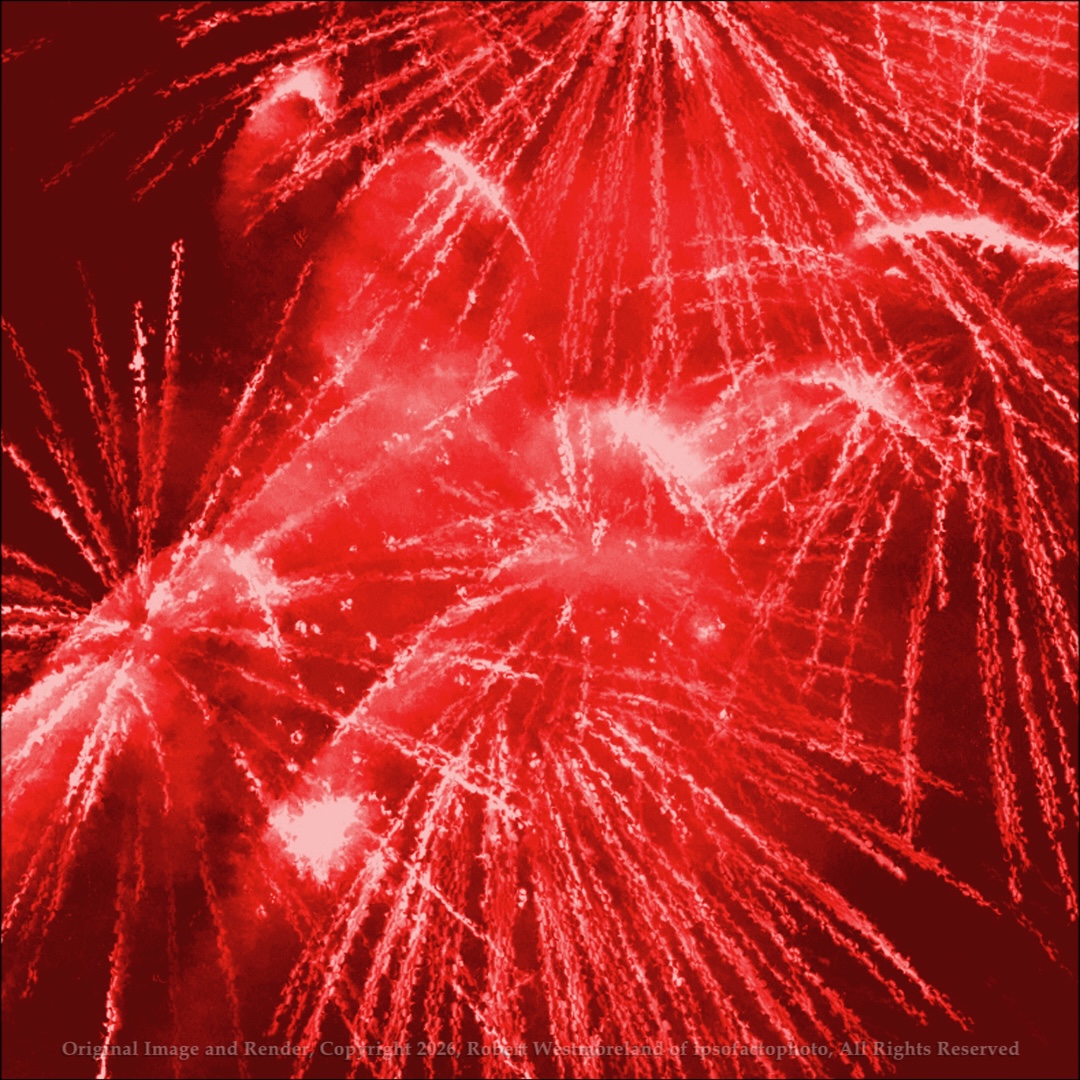 B&W print digitally scanned, then manipulated on a Mac IIci desktop
Go with the flow or get left behind
So I summoned my ‘inner geek’ and jumped into desktop computers and digital image manipulation. I’ve been using Photoshop since version 3.0, running from a Mac IIci (OS7.2). Back then, applying one PS filter effect could take 20 minutes.
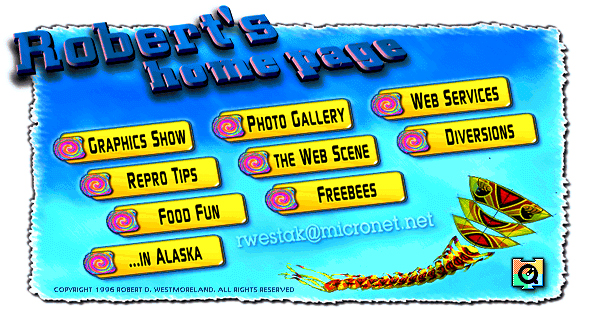 Home page to my first website, more of a ‘proof of concept’, 1996
I’ll admit, I did not do a lot of photography during this period of my life. As far as I was concerned, digital cameras were still not up to the task… I tried several before acquiring my first, a Nikon CoolPix 990… with a whopping 3.4MP image sensor. It took great pictures but of little commercial value. All the cutting edge stuff was way too expensive.
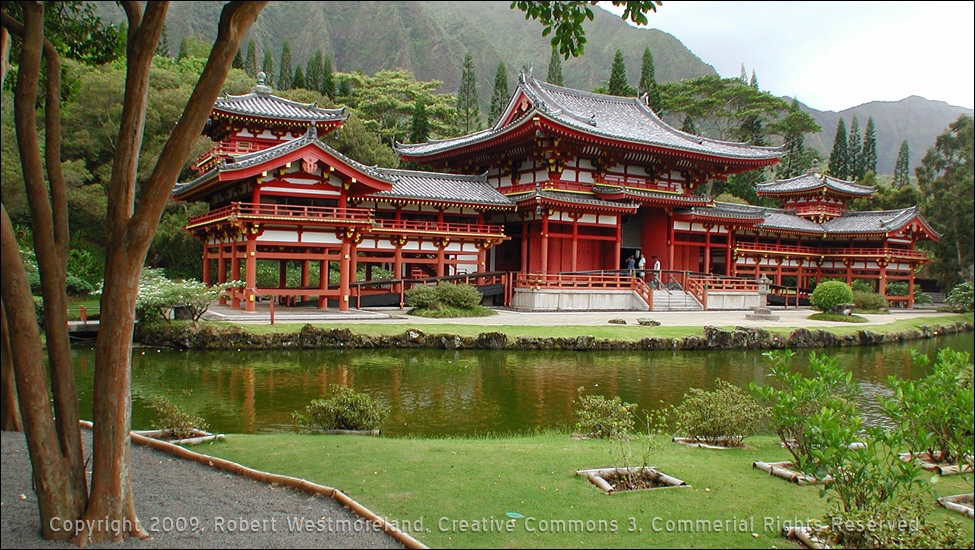 Buddhist Temple, Honolulu, Hawaii, taken with Nikon Coolpix 990
So I kept busy teaching myself HTML and working on the GUI for my first website. That vanity project finally made it to the Net in 1996, 30 years ago. That was followed by a website dedicated to ipso facto photo. I even worked briefly as a webpage designer for Internet Alaska before they were absorbed by AT&T.
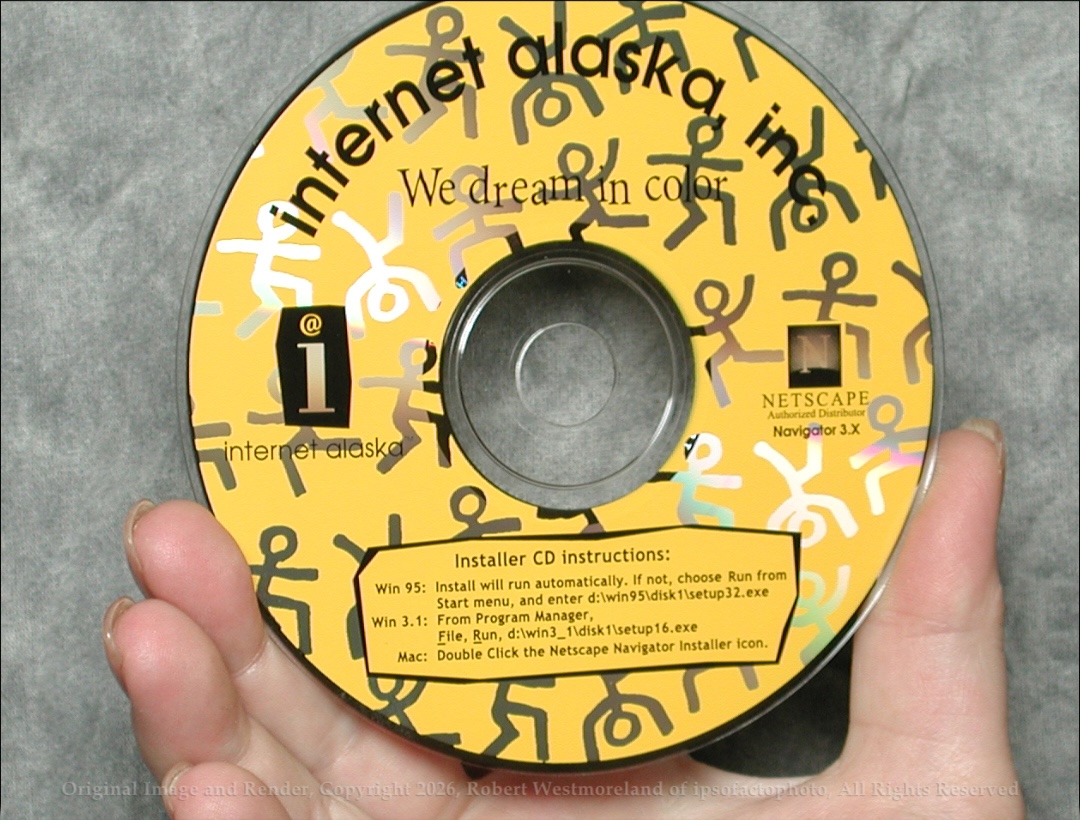 Internet Alaska Install CD I designed
Marketing 101
My first effort to produce prints and sell them over the Net, actually began in about 2004-2005 while still living in Anchorage. Epson had introduced new inkjet printers with tech based on ‘pigmented’ inks making them relatively fade-proof.
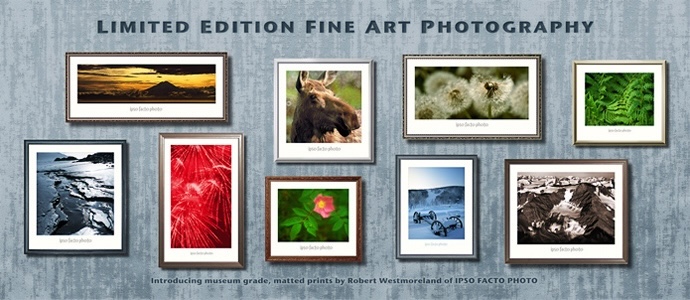 A rack-card from thermo-wax printer, 2004?
This development was not lost on the ‘brick and mortar’ art galleries and interior designers of the day. It was a way to cover walls at a fraction of the cost of a formal painting. That ‘Giclée driven’ art-fad eventually imploded when the upscale art market became saturated with giant prints produced in editions of 250 or more.
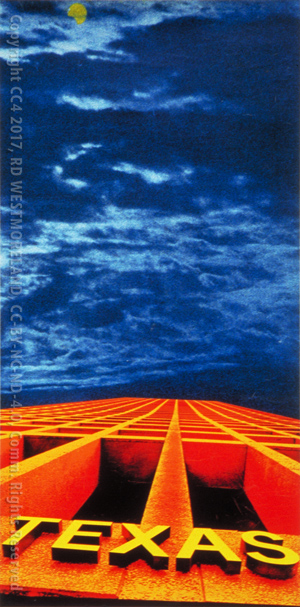 A B&W composite image rendered as a posterization from litho film, pre-digital era
I’m always interested as to who might like this or that print and why. What’s its appeal? I like it, but will someone else? Authenticity also matters. So, marketing via the internet? A dirty word for some ‘creatives’. But, once again, I needed to set this aside to deal with other stuff.
Rob in Puerto Rico, August 2009…
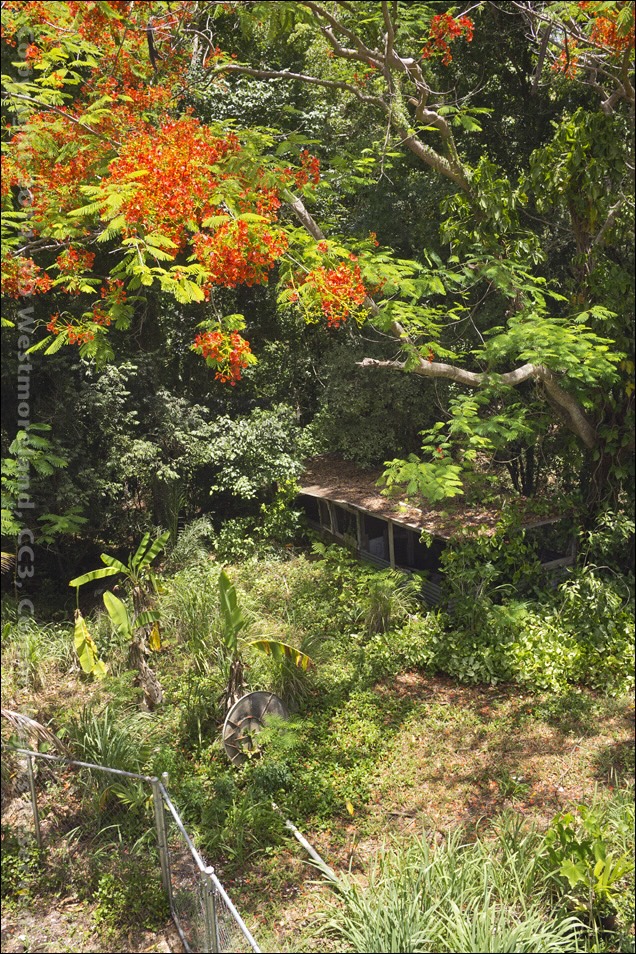 Look’n Out My Back Door
I relocated to Puerto Rico from Willow, Alaska in late 2009. Regarding my time in Puerto Rico, it’s well documented on my other website- ‘The Scurvy Dog’s Puerto Rican Blog’. Yeah, that’s me dressed as a pirate.
As part of that effort, I took a stab at making YouTube videos and made a few. I created the ‘Dog’s Blog’ from scratch using Artisteer, a computer app for making WordPress templates. Then I posted it to the Net just a few days before making my first trip to the island. There are many, many posts and hundreds of photos spread over several years. My last post was about Hurricane Maria. So yea, it’s been too long since I put up anything new.
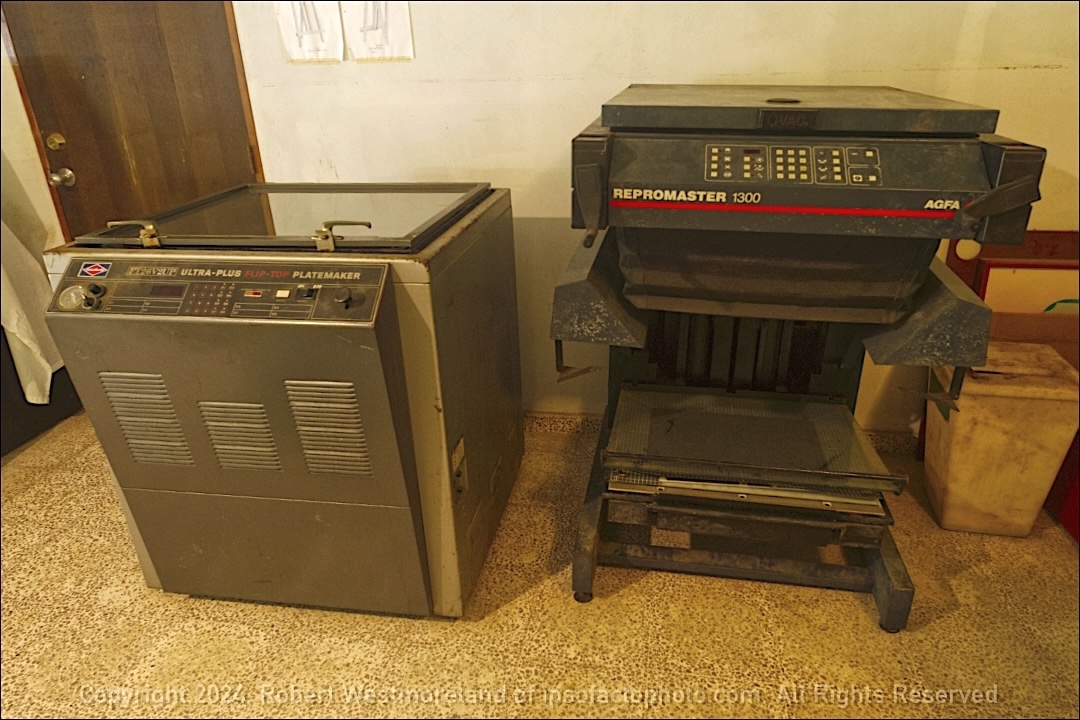 NuArc plate-burner and AGFA process camera from local printshop
I would also like to mention the recent closure of our town’s last remaining print shop. This happened sometime between 2020 and 2024. It was still open when I first got here, but It had been shuttered for a couple years before they needed to empty the building for a remodel. I have no idea where the rest of the gear went, but I was able to rescue most of the prepress department with the help of Nancy, 3 local guys and their pickup… an AGFA process camera, an RA film processor, a NuArc plate burner, an assortment of other pieces and several dozen cans of offset press ink. The camera and plate burner were still functional, but the film processor had several bad rollers.
Done and Done
So I’m basically retired, chasing the dogs and cats, working in the garden, making stuff, shooting when the weather is good, making prints when time allows… posting about some of it. And just hanging out. All things considered, I feel very blessed.
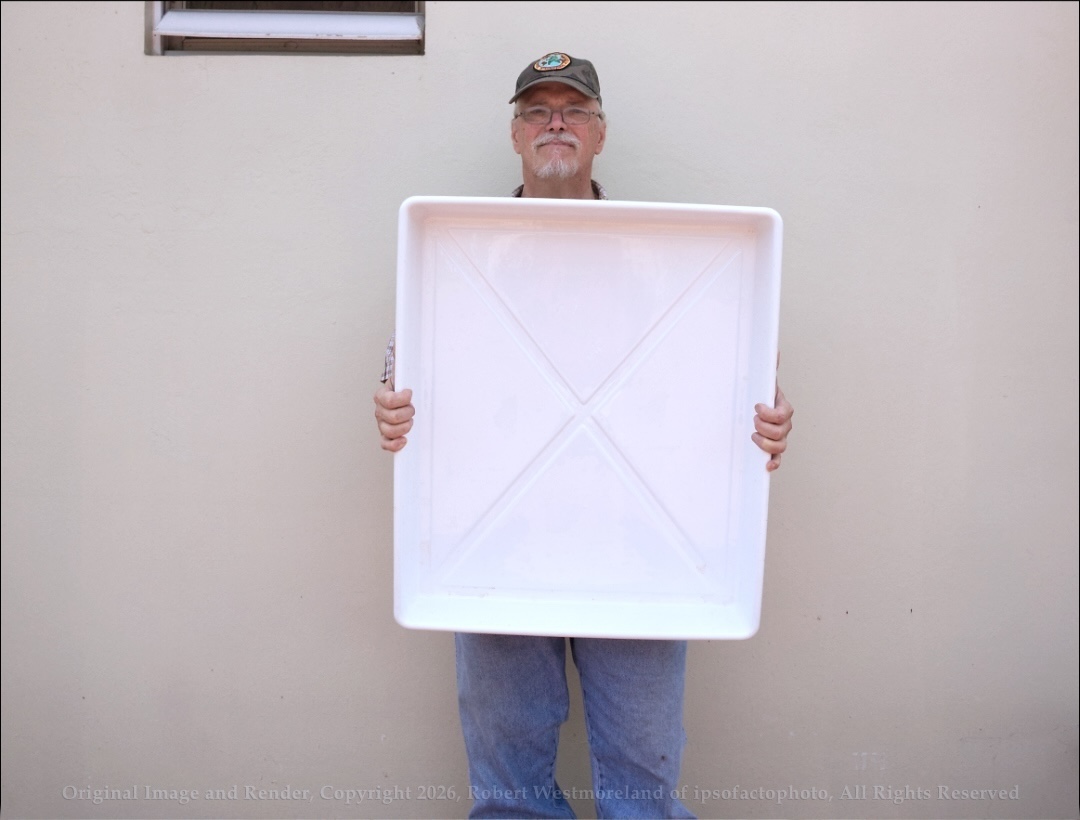 I have three of these in pristine condition
This was a long read. Thanks for hanging in there. Rob