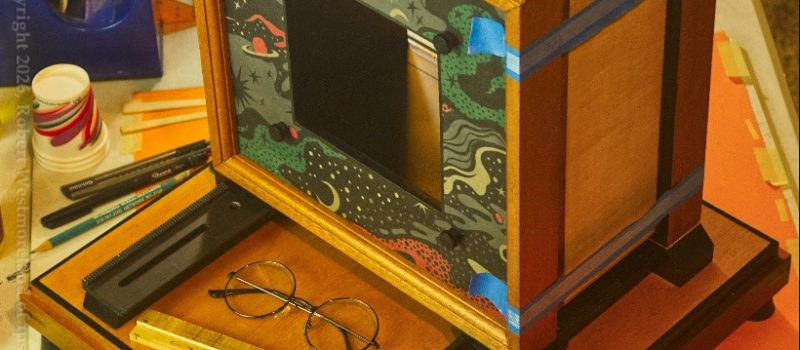
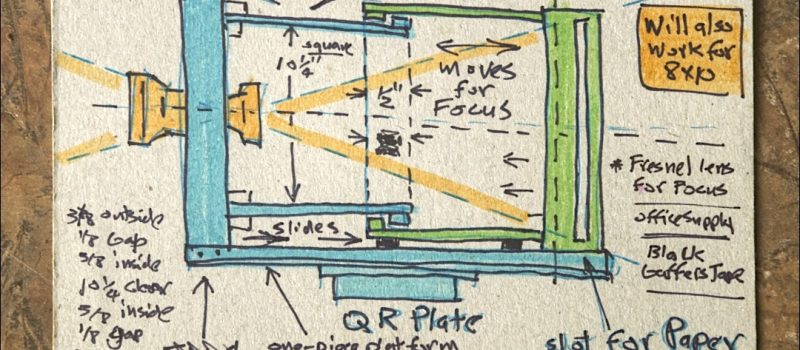
Part Two, The A24- A Pair of Apochromat Lenses
As mentioned in Part 1, these lenses were scavenged from an AGFA® Repromaster process camera (vertical form factor) from the mid-1980’s. They were part of a series of lenses made by Schneider Krueuznach® of Germany.
This G-Claron® series of semi-wide angle, state-of-the-art apochromat lenses pushed optical design to their outer limits.
Before we had flat-bed scanners and digital image correction, lenses for commercial reproduction had to display a perfectly flat-field of view, zero optical distortion, with absolutely no light fall-off towards the corners, as well as perfect red-green-blue color registration (true apochromats). And razor-sharp since they had to render 4 point type to litho film. The preverbal ‘fine print’. They are that good.
 The 210mm & 305mm f9 lenses taken from an AGFA process camera
Optic design is more of a balancing act… a set of tradeoffs
To achieve those exacting specs, the F-stop was always sacrificed (f8.0 or slower) and were typically short telephotos by design. A true wide-angle lens of this calibre, would be pushing the limits of apochromatic design. This series of lenses from the 1980’s did just that, by tweaking the image circle a bit wider… 64º to be exact. This made for a much more compact process-camera… you didn’t need a ladder to use it!
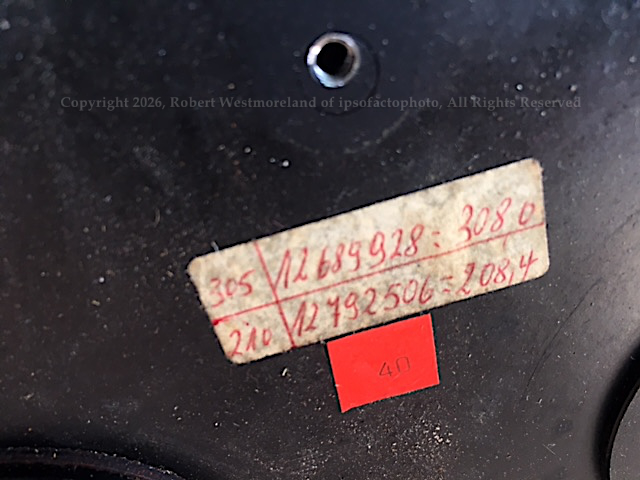 Actual focal-lengths as measured from the factory
These G-CLARON® lenses do not incorporate shutters since exposure times to litho film was in the 10’s of seconds, not fractions there of. As I was to discover, they were indeed designed to take a Copal shutter! I went to eBay and tracked down clean, used shutters… it was an easy matter to simply screw them together. Neither of the used shutters I scored start at F9.0. That is something I will eventually correct as the ‘F-stop strips’ can be swapped out. However, it makes no diff as to how the lens/shutter combo works. So I’m not worried about it for now.
 210mm f9 lens diagram from Schneider Krueuznach® brochure
As can be discerned from the mechanical drawing, this is a cross-section of the 210mm F9. It’s worth noting that both the 210mm and 305mm lenses use the same Copal/Compur #1 shutter. Since the 305mm has the same angle of view as the 210mm, it will actually cover a full 11”x14”.
A quote from the G-Claron PDF dated 8/98:
“The G-CLARON® is a lens of symmetrical design with six elements in four groups, optimized for 1:1 reproduction. The normally used range of linear magnification is between 5:1 and 1:5. Due to the advantageous price/performance relationship the G-CLARON® may also be used for distances up to infinity by stopping down to F/22 or less. For photographic work the G-CLARON® can be used up to an angle of 64º and is free from mechanical vignetting at F/16 or smaller apertures.”
Yes, both lenses need a good cleaning since the AGFA® process camera sat in a dank and dirty darkroom, unattended for over 20 years. After running a few exposure tests on AGFA® and then Kodak® B&W photo-paper, I concluded that they are both perfectly usable as they are. That said, I’m rounding up what I need to disassemble and clean the elements.
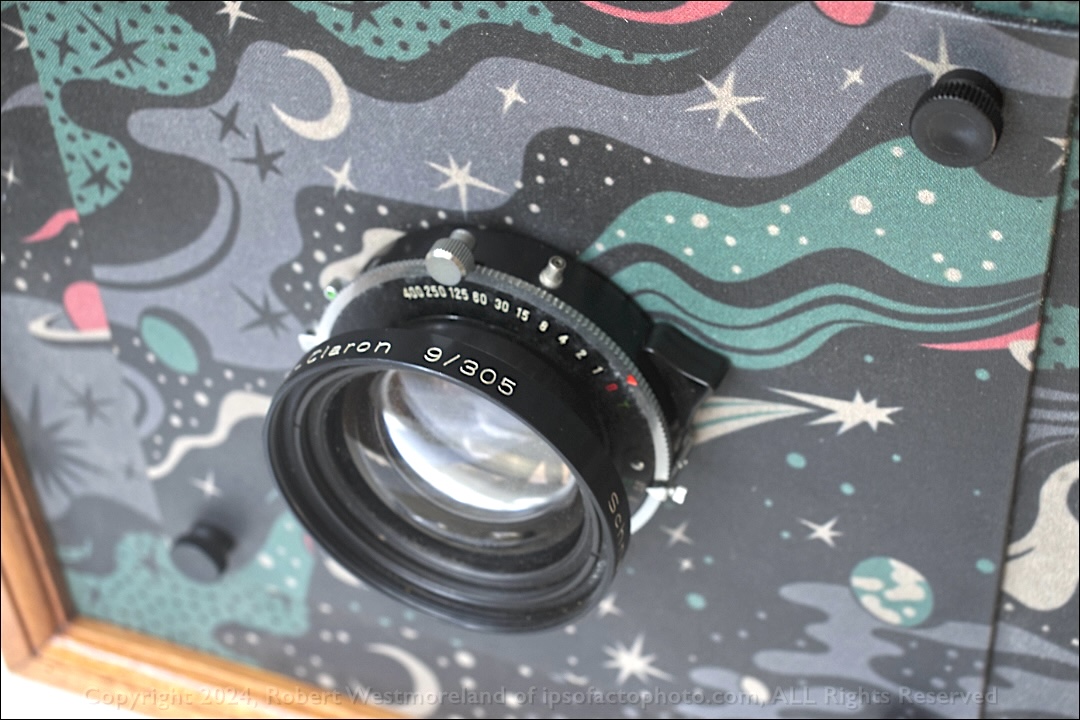 The 305mm f9 lens with shutter as mounted to the A24 8×10 Box Camera
Having worked with true apochromats in the past, I’m pretty apprehensive when contemporary auto-focus lens makers sling the chromatic aberration (CA) term around. Issues regarding chromatic aberration is always high on my list when considering a new lens. And to be honest, there are a few lens makers who have addressed the issue quite well, but don’t declare it in their marketing. It’s easy to make a lens that’s sharp in the middle of the frame, but 2 pixels of uncorrected chromatic-shift in the corners will absolutely trash the ‘perceived’ resolution, no matter how well the lens resolves detail.
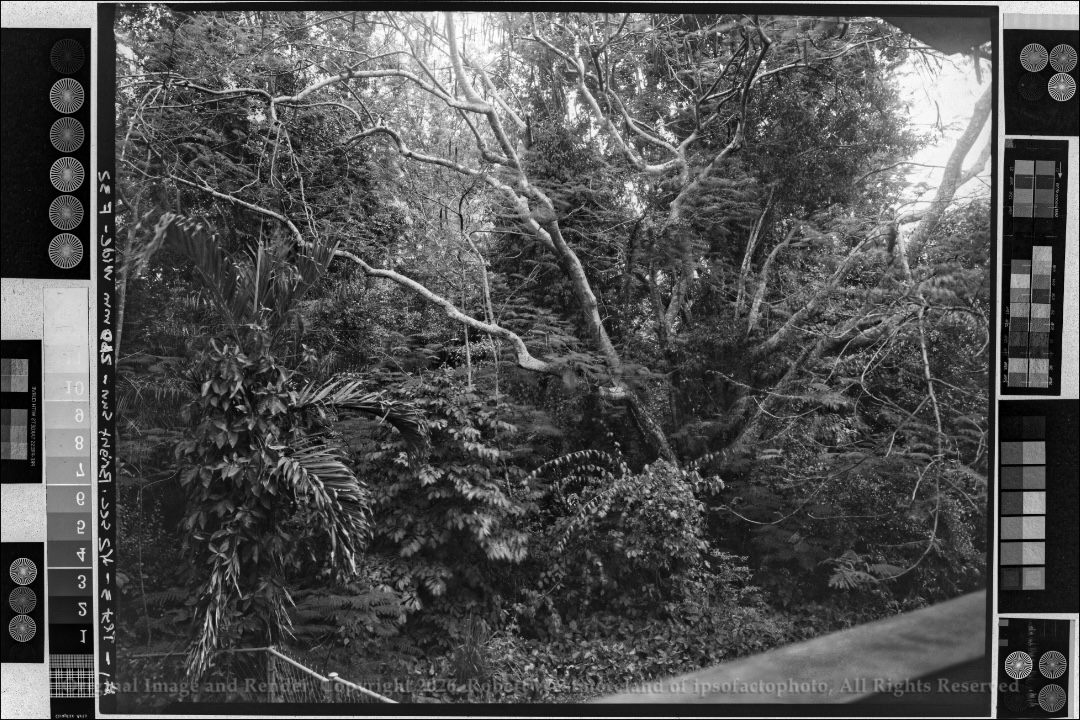 Captured from back porch using A24 8×10 Box Camera with G-Claron 210 F9.0, recorded to Kodak Panalure Select RC, there is wind…
As I’m sure some of you have surmised, CA can be corrected by a digital camera’s internal processor or in post-processing (which I do as a matter of routine), or by applying ‘AI’ to the image, but the less optical issues the lens exhibits, the better.
The exception to the above, is if you are shooting something like B&W X-Ray film, or a pan-chromatic B&W film through a strong colored filter. At that point CA is not a big deal.
That covers everything to be said about the lenses. The only thing I could add to that, is- “The Camera Matters, but the Lens Matters More!”
RDW